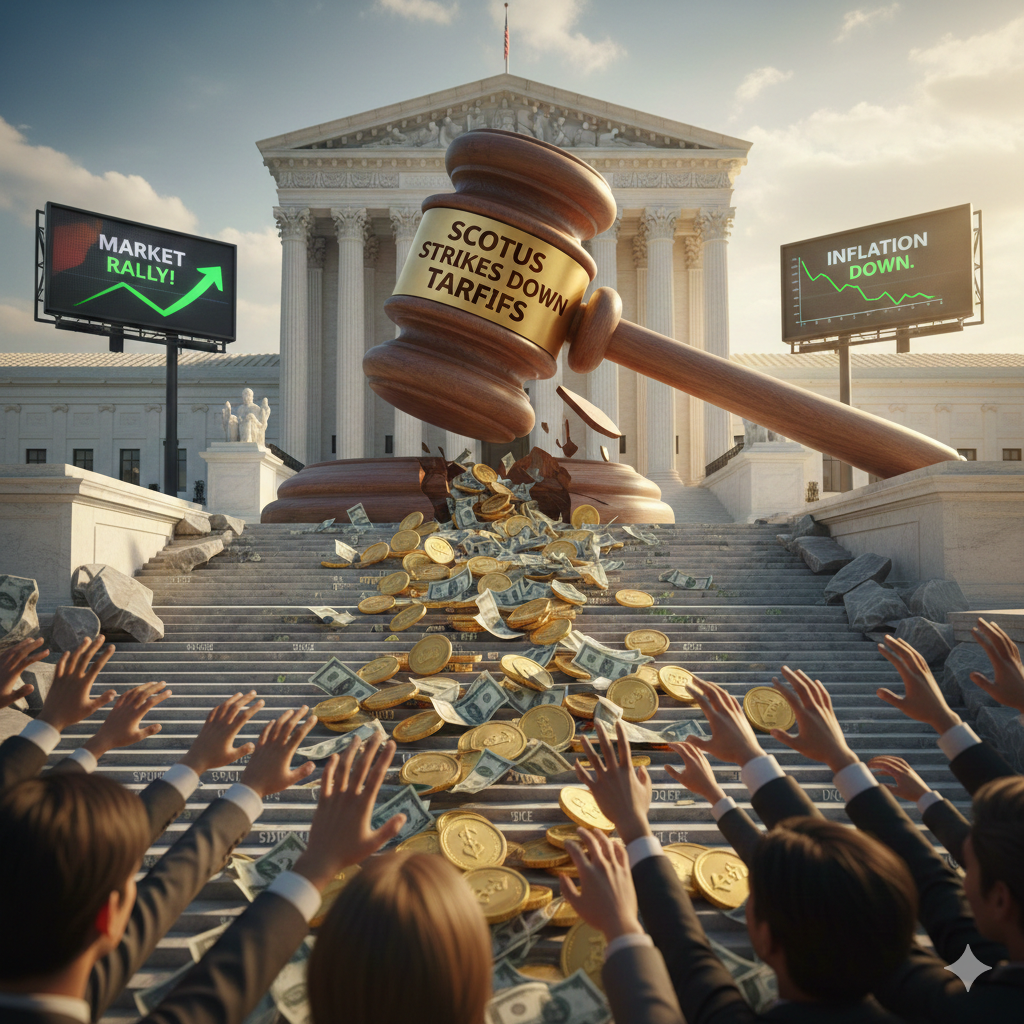
In a historic decision that has fundamentally shifted the landscape of American trade policy, the U.S. Supreme Court (SCOTUS) ruled 6-3 on Friday, February 20, 2026, to strike down the sweeping global tariffs imposed by the Trump administration. The ruling, authored by Chief Justice John Roberts, invalidates the use of the International Emergency Economic Powers Act (IEEPA) as a mechanism for the President to unilaterally levy import taxes.
This decision marks the most significant legal defeat for President Trump’s second-term economic agenda. It has immediate consequences for the stock market today, provides a new variable for the upcoming PCE report, and triggers a multi-billion-dollar “refund mess” for U.S. importers.
⚖️ The SCOTUS Tariff Decision: A Constitutional Limit on Power
Gemini said
Supreme Court Strikes Down Trump Tariffs: Market Impact, IEEPA Ruling, and the PCE Inflation Outlook
In a historic decision that has fundamentally shifted the landscape of American trade policy, the U.S. Supreme Court (SCOTUS) ruled 6-3 on Friday, February 20, 2026, to strike down the sweeping global tariffs imposed by the Trump administration. The ruling, authored by Chief Justice John Roberts, invalidates the use of the International Emergency Economic Powers Act (IEEPA) as a mechanism for the President to unilaterally levy import taxes.
This decision marks the most significant legal defeat for President Trump’s second-term economic agenda. It has immediate consequences for the stock market today, provides a new variable for the upcoming PCE report, and triggers a multi-billion-dollar “refund mess” for U.S. importers.
⚖️ The SCOTUS Tariff Decision: A Constitutional Limit on Power
The case, Learning Resources, Inc. v. Trump, challenged the administration’s “Liberation Day” tariffs—a 10% baseline duty on all imports and additional reciprocal duties of up to 50% on various countries. The administration argued that the 1977 IEEPA allowed the President to “regulate” imports during a national emergency.
The Majority Opinion
Chief Justice Roberts, joined by the court’s three liberal justices and Trump appointees Neil Gorsuch and Amy Coney Barrett, rejected this “extraordinary assertion of power.” The court held that the U.S. Constitution explicitly grants the power to lay and collect taxes and duties to Congress, not the Executive Branch.
“The Framers did not vest any part of the taxing power in the Executive Branch. When Congress grants the power to impose tariffs, it does so clearly and with careful constraints. It did neither in IEEPA.” — Chief Justice John Roberts
The Dissent
Justices Samuel Alito, Clarence Thomas, and Brett Kavanaugh dissented. Justice Kavanaugh argued that while the tariffs might be controversial as policy, they were legally sound under the broad language of IEEPA, which had been used dozens of times by previous presidents to impose sanctions.
Gemini said
Supreme Court Strikes Down Trump Tariffs: Market Impact, IEEPA Ruling, and the PCE Inflation Outlook
In a historic decision that has fundamentally shifted the landscape of American trade policy, the U.S. Supreme Court (SCOTUS) ruled 6-3 on Friday, February 20, 2026, to strike down the sweeping global tariffs imposed by the Trump administration. The ruling, authored by Chief Justice John Roberts, invalidates the use of the International Emergency Economic Powers Act (IEEPA) as a mechanism for the President to unilaterally levy import taxes.
This decision marks the most significant legal defeat for President Trump’s second-term economic agenda. It has immediate consequences for the stock market today, provides a new variable for the upcoming PCE report, and triggers a multi-billion-dollar “refund mess” for U.S. importers.
⚖️ The SCOTUS Tariff Decision: A Constitutional Limit on Power
The case, Learning Resources, Inc. v. Trump, challenged the administration’s “Liberation Day” tariffs—a 10% baseline duty on all imports and additional reciprocal duties of up to 50% on various countries. The administration argued that the 1977 IEEPA allowed the President to “regulate” imports during a national emergency.
The Majority Opinion
Chief Justice Roberts, joined by the court’s three liberal justices and Trump appointees Neil Gorsuch and Amy Coney Barrett, rejected this “extraordinary assertion of power.” The court held that the U.S. Constitution explicitly grants the power to lay and collect taxes and duties to Congress, not the Executive Branch.
“The Framers did not vest any part of the taxing power in the Executive Branch. When Congress grants the power to impose tariffs, it does so clearly and with careful constraints. It did neither in IEEPA.” — Chief Justice John Roberts
The Dissent
Justices Samuel Alito, Clarence Thomas, and Brett Kavanaugh dissented. Justice Kavanaugh argued that while the tariffs might be controversial as policy, they were legally sound under the broad language of IEEPA, which had been used dozens of times by previous presidents to impose sanctions.
💹 Stock Market Today: How Wall Street is Reacting
The stock market today responded with a “relief rally” in sectors most burdened by import costs. While the broader indices like the S&P 500 and Dow Jones today saw moderate gains, the internal sector rotation was more dramatic.
Winners and Losers on the Trading Floor
-
Retail and Consumer Staples: Companies like Walmart, Target, and Costco saw share prices climb. These firms have been grappling with compressed margins due to the IEEPA duties.
-
Automotive Industry: With the threat of 25% tariffs on Canadian and Mexican auto parts effectively neutralized (for now), domestic automakers saw a boost in mid-day trading.
-
The “Refund” Stocks: Large-scale importers that have already paid billions in duties are now being eyed by investors as potential recipients of massive cash inflows via the U.S. Customs and Border Protection (CBP) refund process.
-
U.S. Steel and Domestic Manufacturers: Some domestic producers saw a slight dip, as the removal of global tariffs means increased competition from cheaper foreign imports.
| Index / Asset | Performance (Feb 20, 2026) |
| S&P 500 | 📈 +0.52% |
| Dow Jones Industrial Average | 📈 +0.42% |
| Nasdaq Composite | 📈 +0.50% |
| U.S. Dollar Index (DXY) | 📉 -0.20% |
Gemini said
Supreme Court Strikes Down Trump Tariffs: Market Impact, IEEPA Ruling, and the PCE Inflation Outlook
In a historic decision that has fundamentally shifted the landscape of American trade policy, the U.S. Supreme Court (SCOTUS) ruled 6-3 on Friday, February 20, 2026, to strike down the sweeping global tariffs imposed by the Trump administration. The ruling, authored by Chief Justice John Roberts, invalidates the use of the International Emergency Economic Powers Act (IEEPA) as a mechanism for the President to unilaterally levy import taxes.
This decision marks the most significant legal defeat for President Trump’s second-term economic agenda. It has immediate consequences for the stock market today, provides a new variable for the upcoming PCE report, and triggers a multi-billion-dollar “refund mess” for U.S. importers.
⚖️ The SCOTUS Tariff Decision: A Constitutional Limit on Power
The case, Learning Resources, Inc. v. Trump, challenged the administration’s “Liberation Day” tariffs—a 10% baseline duty on all imports and additional reciprocal duties of up to 50% on various countries. The administration argued that the 1977 IEEPA allowed the President to “regulate” imports during a national emergency.
The Majority Opinion
Chief Justice Roberts, joined by the court’s three liberal justices and Trump appointees Neil Gorsuch and Amy Coney Barrett, rejected this “extraordinary assertion of power.” The court held that the U.S. Constitution explicitly grants the power to lay and collect taxes and duties to Congress, not the Executive Branch.
“The Framers did not vest any part of the taxing power in the Executive Branch. When Congress grants the power to impose tariffs, it does so clearly and with careful constraints. It did neither in IEEPA.” — Chief Justice John Roberts
The Dissent
Justices Samuel Alito, Clarence Thomas, and Brett Kavanaugh dissented. Justice Kavanaugh argued that while the tariffs might be controversial as policy, they were legally sound under the broad language of IEEPA, which had been used dozens of times by previous presidents to impose sanctions.
💹 Stock Market Today: How Wall Street is Reacting
The stock market today responded with a “relief rally” in sectors most burdened by import costs. While the broader indices like the S&P 500 and Dow Jones today saw moderate gains, the internal sector rotation was more dramatic.
Winners and Losers on the Trading Floor
-
Retail and Consumer Staples: Companies like Walmart, Target, and Costco saw share prices climb. These firms have been grappling with compressed margins due to the IEEPA duties.
-
Automotive Industry: With the threat of 25% tariffs on Canadian and Mexican auto parts effectively neutralized (for now), domestic automakers saw a boost in mid-day trading.
-
The “Refund” Stocks: Large-scale importers that have already paid billions in duties are now being eyed by investors as potential recipients of massive cash inflows via the U.S. Customs and Border Protection (CBP) refund process.
-
U.S. Steel and Domestic Manufacturers: Some domestic producers saw a slight dip, as the removal of global tariffs means increased competition from cheaper foreign imports.
📉 The Inflation Equation: Impact on the PCE Report
Economists are now scrambling to adjust their forecasts for the Personal Consumption Expenditures (PCE) Price Index, the Federal Reserve’s preferred inflation metric.
Prior to the Supreme Court ruling on tariffs, the IEEPA duties were projected to add significantly to headline inflation. The Tax Foundation had estimated that these tariffs would increase the tax burden on American households by roughly $1,300 per year in 2026.
Why the PCE Report Matters Now
-
Direct Price Deflation: With the 10% global baseline tariff removed, the cost of imported electronics, clothing, and machinery should theoretically drop.
-
The “Sticky” Price Risk: While the legal barrier is gone, many retailers have already signed contracts at higher prices. The PCE report will reveal how much of this “tariff relief” is actually passed on to the consumer versus kept as corporate profit.
-
Federal Reserve Outlook: If the SCOTUS tariff ruling leads to a cooling of inflation, it may embolden the Fed to accelerate interest rate cuts, providing further tailwinds for the S&P 500.
🏗️ The “Refund Mess”: $175 Billion at Stake
One of the most complex outcomes of the SCOTUS tariff decision is the fate of the money already collected. Since the tariffs were implemented in April 2025, the U.S. government has collected an estimated $175 billion in IEEPA-based duties.
-
Jurisdiction: The Supreme Court confirmed that the U.S. Court of International Trade (CIT) is the proper forum for companies to seek refunds.
-
Fiscal Impact: The Committee for a Responsible Federal Budget (CRFB) warned that if all $175 billion is refunded, it could widen the federal deficit by nearly $2 trillion over the next decade when accounting for lost future revenue.
-
The Process: Importers will likely need to file “protests” with the CBP. Legal experts warn this could take years to resolve, creating a long-term litigation cycle for major corporations.
🔄 What Remains? Section 301 and Section 232 Tariffs
It is vital for investors and businesses to understand that not all tariffs were struck down. The Supreme Court’s decision was specific to the IEEPA.
-
Section 301 (Trade Act of 1974): Tariffs targeting “unfair trade practices” (primarily used against China) remain in effect.
-
Section 232 (Trade Expansion Act of 1962): Tariffs based on “national security” (such as those on steel and aluminum) also remain untouched by this specific ruling.
The Administration’s “Game Two” Plan
President Trump has already signaled that he will move to re-impose duties using these alternative authorities. The White House may look toward Section 122 of the Trade Act of 1974, which allows for a 15% tariff for 150 days to address balance-of-payment deficits, though this would eventually require Congressional approval for extension.
🏁 Conclusion: A New Era of Trade Uncertainty
The Supreme Court decision on tariffs has provided a temporary reprieve for global trade, but it has also created a period of profound uncertainty. While the stock market today is celebrating the removal of the IEEPA duties, the looming “Game Two” from the White House suggests that the “tariff war” is far from over.
For consumers, the focus shifts to the next PCE report to see if the legal victory at the Supreme Court translates into lower prices at the grocery store and the gas pump. For now, the ruling stands as a powerful reminder of the constitutional “separation of powers” and the limits of executive authority in the 21st century.